
Industrial ball valves
Floating and trunnion-mounted ball valves in cast and forged steel, supplemented by special designs for demanding operating conditions.
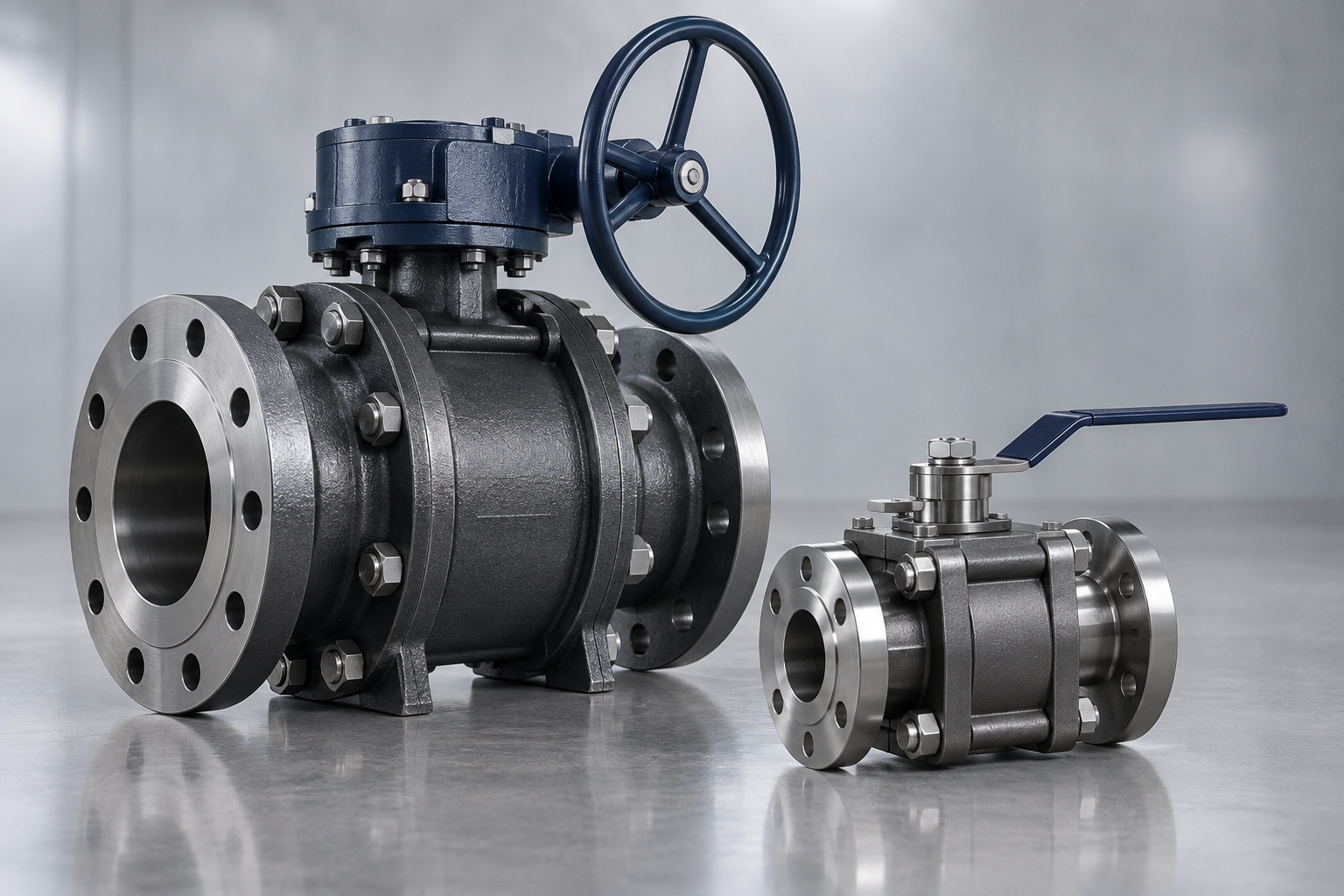
Designs
Floating ball valves
The ball is not fixed in the body. It is held between the two seat rings and shifts slightly under pressure towards the downstream seat, where it seals. This design is used mainly for smaller nominal sizes and lower pressure classes.
Trunnion-mounted ball valves
The ball is supported top and bottom by trunnions in the body and transfers the medium pressure to the bearings. Spring-loaded seat rings rest against the ball and seal independently of the pressure. Operating torques therefore stay limited, also at large nominal sizes and high pressures.
| Feature | Floating | Trunnion-mounted |
|---|---|---|
| Ball support | between the seat rings | by trunnions in the body |
| Sealing | medium pressure presses the ball onto the seat | spring-loaded seat rings |
| Operating torque | rises with pressure and nominal size | largely independent of the pressure |
| Main use | smaller nominal sizes, lower pressure classes | large nominal sizes, high pressures |
Special designs
Four designs for operating conditions that a standard ball valve does not cover.
- Metal-seated ball valves
- Ball and seat rings seal metal to metal. This design is intended for high temperatures and for abrasive or solids-laden media where soft seats can no longer be used.
- Cryogenic ball valves
- For very cold media such as liquefied gases. Materials and seals are matched to low temperatures, and an extended stem keeps the actuation out of the cold zone.
- Fully welded ball valves
- The body is welded instead of bolted. Without body flanges there are no leak paths to the outside, which suits this design to buried pipelines and long maintenance intervals.
- Top-entry ball valves
- Ball and seat rings are accessible from above through the body cover. Maintenance and seat replacement take place in the line without removing the valve.
Configuration to requirement
We define material, pressure class, end connection, seat system and type of actuation for each order according to the requirement.
| Materials | Body in cast or forged steel; material selected by medium, temperature and applicable code |
|---|---|
| Pressure classes | to requirement and the agreed code (API, ASME, EN) |
| End connections | flanged ends; other end connections to requirement |
| Seat systems | soft-seated or metal-seated, matched to medium and temperature |
| Actuation | hand lever, gear operator with handwheel; other types of actuation to requirement |
Enquiries and quotations
Tell us medium, pressure, temperature, nominal size and end connection. We reply by email with a quotation or with questions on the configuration.